
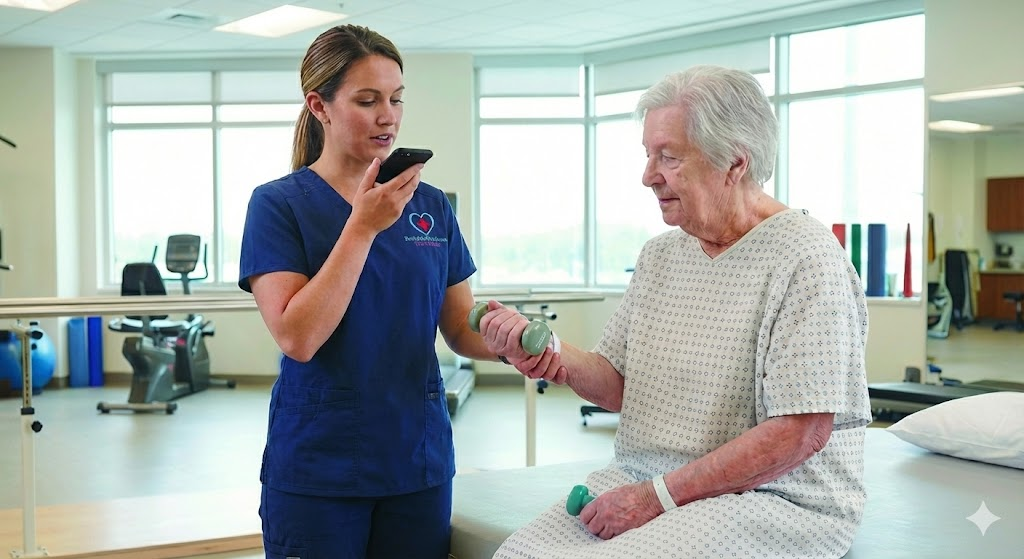
We’re in the middle of rolling out our first Aiva Assistant deployment at a rehab hospital and it’s been eye-opening. After years of voice enabling acute-care nurses, stepping into the world of rehabilitation therapy has shown us just how different (and equally complex) these clinical workflows truly are.
As a reminder, Aiva’s mobile, AI-powered voice assistant lets clinicians document to EHRs like Epic, Cerner and Meditech simply by speaking naturally. It also connects to many other systems clinicians rely on – like policies and procedures, interpreter services, dietary, work orders, messaging, and more. We’ve already generated more than a million EHR updates across health systems like Cedars-Sinai Medical Center and BayCare Health, but this is the first time we’ve brought those capabilities to therapists.
It is important to note that we don’t just support therapists as one group. We support three distinct disciplines, each with its own documentation rhythm and clinical lens:
There are three big workflow differences we discovered between nursing and therapy that shaped ambient documentation in rehab settings.
1. Shift Structure: Structured Schedules vs. Dynamically Shifting Clinical Flow
One of the most striking contrasts between inpatient nursing and rehab therapy is how their days are organized.
Therapists: Scheduled, Session-Based Days
Rehab therapists typically follow a structured daily schedule built around planned, often thirty-minute to hour-long patient sessions. Between those sessions, they carve out dedicated time to complete documentation, collaborate with interdisciplinary team members, educate families, and prepare for upcoming treatments.
Nurses: Dynamic, Rapid-Prioritization Environments
Inpatient nurses, by comparison, manage a constantly shifting environment. They may have 4–6 patients with competing needs, frequent interruptions, unplanned assessments and ongoing collaboration across the care team. Documentation often happens in small pockets of time or all at once during the end-of-shift crunch.
How That Impacts AI Voice Documentation
Because nurses are always on the move, they typically document in pieces, often retrospectively. Therapists, on the other hand, tend to batch documentation after sessions, sometimes relying heavily on memory or quick notes.
This is why it was so amazing to watch therapists’ documentation habits shift immediately once they had access to Aiva. They began documenting in real time, because it was finally easy to capture thoughts, observations, and activities the moment they occurred.
During a recent Aiva implementation for therapies, therapists not only documented in the patient’s presence, they also documented en route between patients – with one therapist documenting in the stairwell on the way to their next appointment. Not only can this save time later in the day, but it can also increase both completeness and accuracy.
2. Observation Length: Short Discrete Entries vs. Long Narrative Assessments
The next major difference we saw was the nature of the documentation.
Nurses: High Volume of Discrete Structured Data
Nurses frequently chart discrete values:
There are free-text flowsheet rows, of course, but the bulk of nurse documentation is structured and captured in a flowsheet list.
Therapists: Narrative-Heavy, Story-Driven Clinical Documentation
Therapists also document discrete metrics like assistance levels, cueing needed, or task completion, but their flowsheets often rely heavily on detailed narratives that describe a patient’s functional progress over time. These narratives are captured in free text flowsheet rows. For example:
These notes can last 1–3 minutes when spoken, contain many observations, and often reflect nuanced clinical judgment. They’re more like “micro-stories” than data points.
The AI Challenge: Knowing When to Keep the Story vs. When to Extract Data
This created one of the most interesting challenges in our deployment: learning when to keep therapists’ explanations as a single narrative entry and when to break elements into structured data fields.
AI can identify discrete data within long narratives, but clinical context matters. A paragraph about mobility may include gait distance, cueing type, and assistance level, but therapists may still want that entire paragraph preserved in a session assessment free text flowsheet row.
Teaching the Assistant when to “hold” a narrative and when to “fold” parts into flowsheet rows became a key part of our optimization.
3. Billing: Almost Everything a Therapist Does Is Billable
In acute care, nursing documentation sometimes ties to quality metrics or reimbursement, but most nurse charting isn’t directly connected to billable units.
For therapists, it’s the opposite.
Therapists Track Time, Modalities, and Units for Nearly Every Service Provided
Rehab flowsheets include dedicated billing rows to capture:
These entries are critical not just for the patient record, but also for downstream claims, revenue, and therapist productivity reporting.
How Voice Charting Helps
Because it’s faster and easier than typing, ambient documentation makes it much more likely that therapists capture billing data in real time and with fewer omissions. That means:
This is one of the areas where ambient documentation has an immediate financial impact.
Looking Ahead
This first rehab deployment has been a rewarding challenge, as well as a reminder that ambient documentation isn’t a one-size-fits-all solution. Nurses and therapists have fundamentally different workflows, documentation goals, and billing requirements. Designing an AI assistant that supports both requires a comprehensive understanding of their scope of practice and the realities of their day-to-day workflows.
We’ll be sharing more soon, including results, real-world impact, and how therapists are using other Aiva features like EHR read-back, hands-free policy lookup, and reminders.
Rehab therapists change lives every day. We’re excited to build tools that help them focus more on patients and less on the keyboard!